Tutoriels vidéo
Tutoriels pas à pas pour créer des plans de scène, des listes d'entrées, des mixages retours et des fiches techniques avec Techrider.live.
 1:16Tutoriel vidéo
Pink Noise for Live Sound: Test a PA Safely
Pink noise is a broadband test signal, not a tuning target. Learn what equal energy per octave means, how to compare PA zones and audience positions, why one RTA trace is not the room, and what to …
15 septembre 2026 1:17Tutoriel vidéo
Mixer Pad Switch vs Gain: Stop Input Clipping
A pad and a gain control change level at different points. Learn how to find the first overloaded circuit, choose between microphone, DI, and console pads, reset gain, and document the confirmed in…
15 septembre 2026 1:17Tutoriel vidéo
Speaker Impedance Explained: Ohms, Loads & Amplifier Matching
Understand speaker impedance for live sound: nominal versus actual load, what parallel cabinets do, how to match an amplifier and loudspeakers, and how to document every output channel.
13 septembre 2026 1:21Tutoriel vidéo
PA Headroom Explained: Peaks, Clipping & System Margin
A practical guide to PA headroom in live sound: what the margin really means, where clipping can happen, how to find the first failing stage, and what belongs in a technical rider.
13 septembre 2026 1:14Tutoriel vidéo
Front Fill vs Delay Speakers: Coverage & Timing Explained
Compare front fills and delay speakers in a live PA: which audience zones they serve, how feeds and timing differ, and what belongs in the technical rider.
13 septembre 2026 1:15Tutoriel vidéo
Subwoofer Crossovers Explained: Mains, Subs & Alignment
A practical guide to live sound crossovers: how mains and subwoofers share the frequency range, why there is no universal crossover number, and how to document the processing boundary.
13 septembre 2026 1:18Tutoriel vidéo
FOH vs Monitor Engineer: Who Mixes What at a Live Show?
The FOH engineer mixes for the audience. The monitor engineer mixes wedges and in-ear monitors for performers—but the handoff goes much deeper than two consoles.
11 septembre 2026 1:18Tutoriel vidéo
Technical Rider vs Venue Tech Pack: The Advance Explained
An artist technical rider describes the show. A venue tech pack describes the room. Neither replaces the other—and treating a request or inventory list as a confirmed promise causes show-day problems.
11 septembre 2026 1:19Tutoriel vidéo
Active vs Passive PA Speakers: Power, Cabling & System Design
Active PA speakers contain amplification. Passive speakers depend on an external amplifier—but that is only the start of the system decision.
11 septembre 2026 1:19Tutoriel vidéo
Line Array vs Point Source Speakers: Which PA Design Fits?
A line array is not automatically a better PA system. The right design depends on audience geometry, coverage, throw, trim height, sightlines, fills, delays, subwoofers, processing, prediction, and…
11 septembre 2026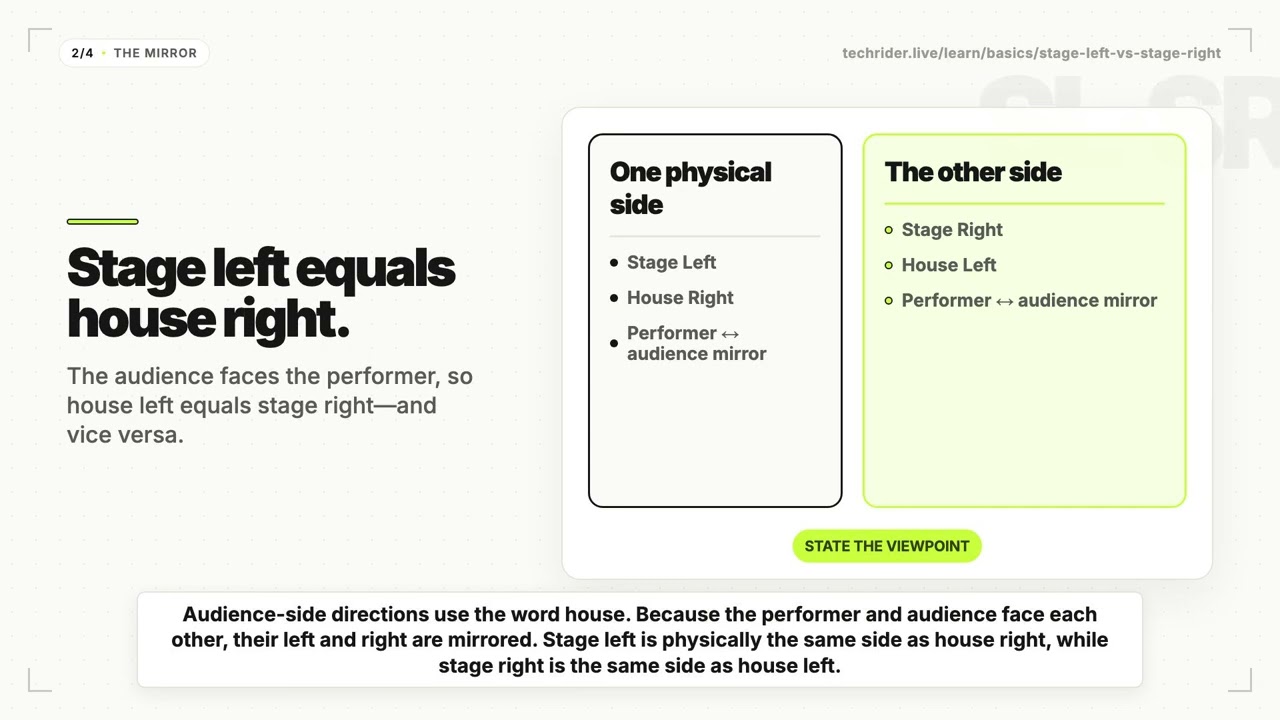 1:09Tutoriel vidéo
Stage Left vs Stage Right: The Performer’s Perspective Explained
Stage left and stage right are always from the performer's perspective facing the audience. Learn the mirror relationship with house left and house right, plus the simple difference between upstage…
25 août 2026 1:19Tutoriel vidéo
Pre-Fader vs Post-Fader Aux Sends: Monitors, Effects & Routing
What changes when an aux send is pre-fader or post-fader? See why monitors often start pre, effects often start post, and why pre-fader does not automatically mean pre-EQ, pre-compressor, or pre-mute.
25 août 2026 1:18Tutoriel vidéo
Gain Staging for Live Sound: Headroom, Noise & Clipping Explained
Gain staging is not one knob: how to set useful signal levels from source through preamp, channel, bus, processor, and amplifier — while leaving headroom and fixing the first stage that actually clips.
25 août 2026 1:15Tutoriel vidéo
Live Sound Signal Flow: From Microphone to Speaker
Trace a live sound signal from the source to the loudspeaker—and learn how to find the first boundary where it fails. This visual explainer follows stage I/O, the console, buses, outputs, system pr…
25 août 2026 0:13Tutoriel vidéo
Stop Typing 30 Channel Names on Your X32
Still typing channel names one by one before soundcheck?
11 août 2026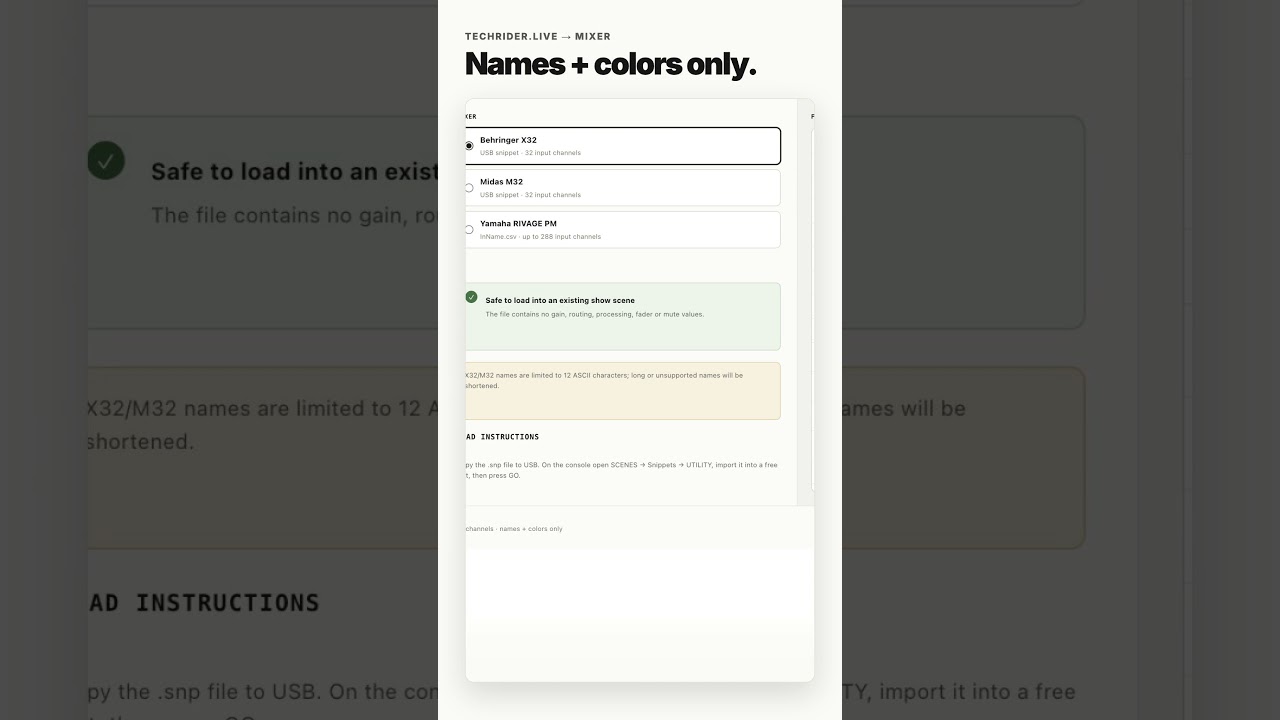 0:13Tutoriel vidéo
Will This X32 Import Overwrite Your Mix? No.
Worried that importing channel names will overwrite your existing show scene?
11 août 2026 0:13Tutoriel vidéo
One Channel List for X32, M32 & Yamaha RIVAGE PM
Build your input list once, then export mixer-ready channel names and colors for Behringer X32, Midas M32, or Yamaha RIVAGE PM.
11 août 2026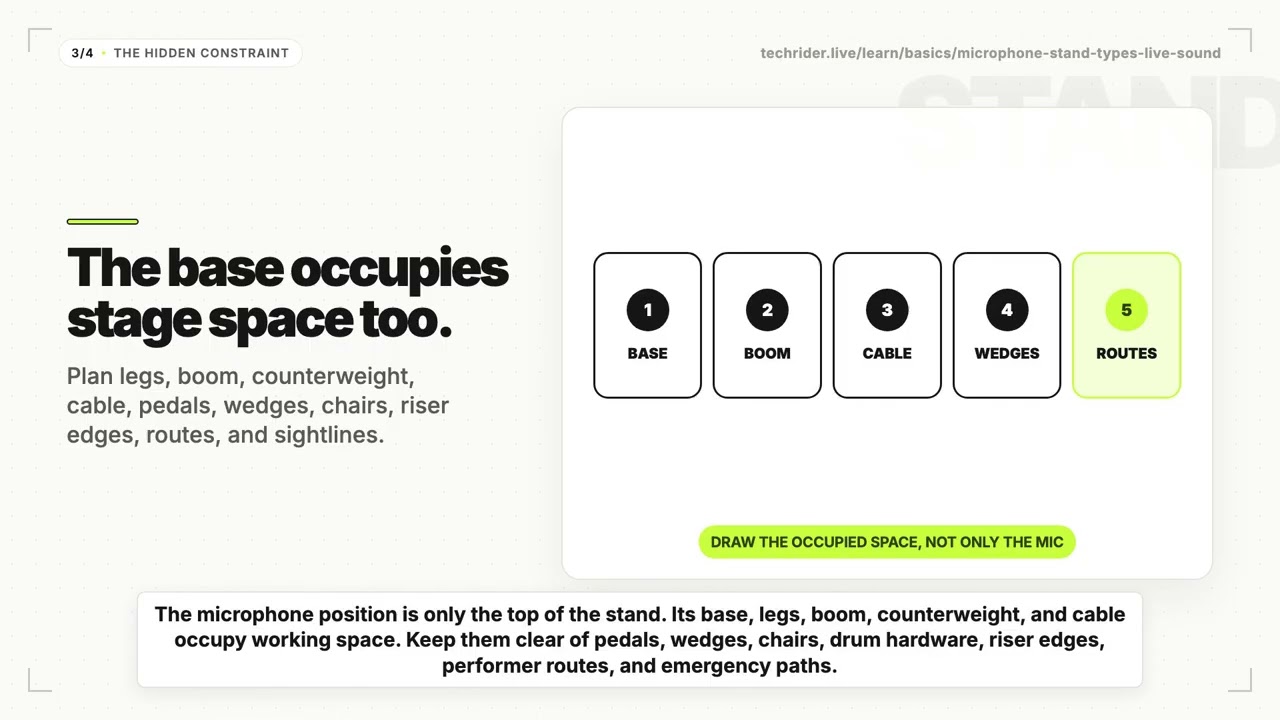 1:13Tutoriel vidéo
Microphone Stand Types for Live Sound
Straight stands, tripod booms, short booms, and desktop stands each solve a different live-sound problem. Learn how to choose the right stand for vocals, instruments, amplifiers, drums, and compact…
11 août 2026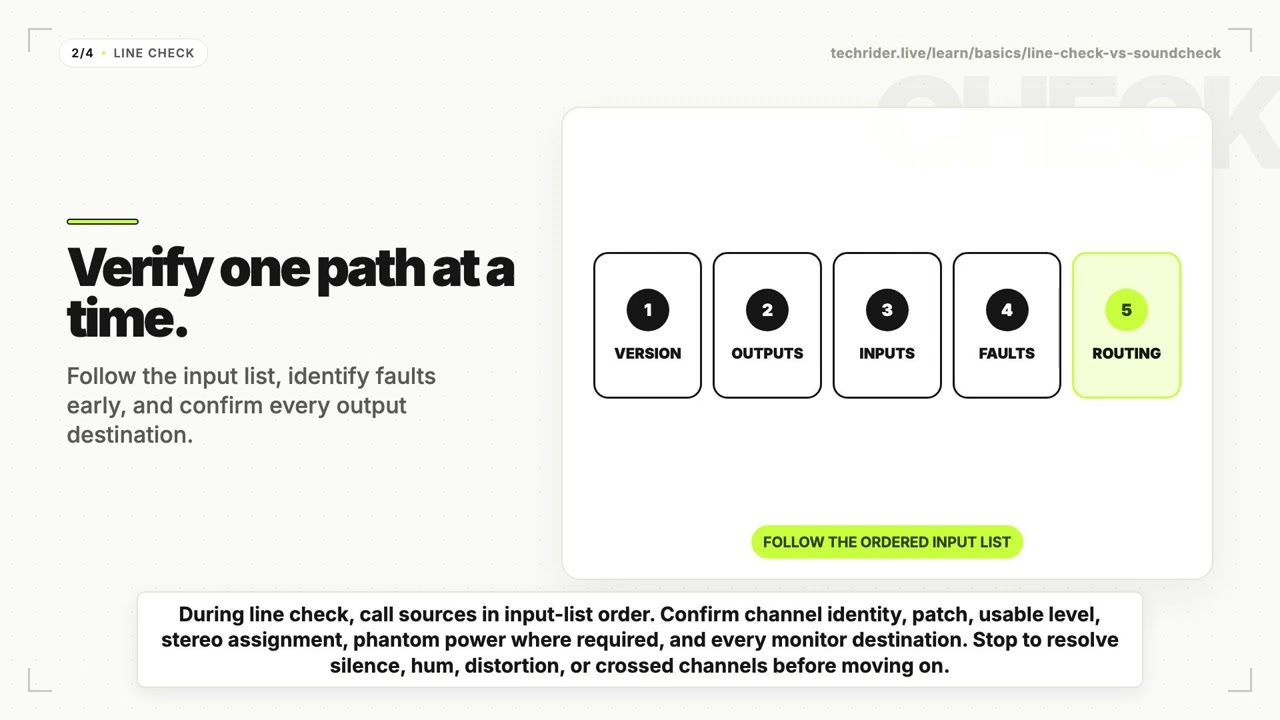 1:13Tutoriel vidéo
Line Check vs Soundcheck: What’s the Difference?
A line check confirms that every input reaches the right channel at a usable level. A soundcheck goes further: the band plays, balances are shaped, monitors are adjusted, and the room mix is refine…
11 août 2026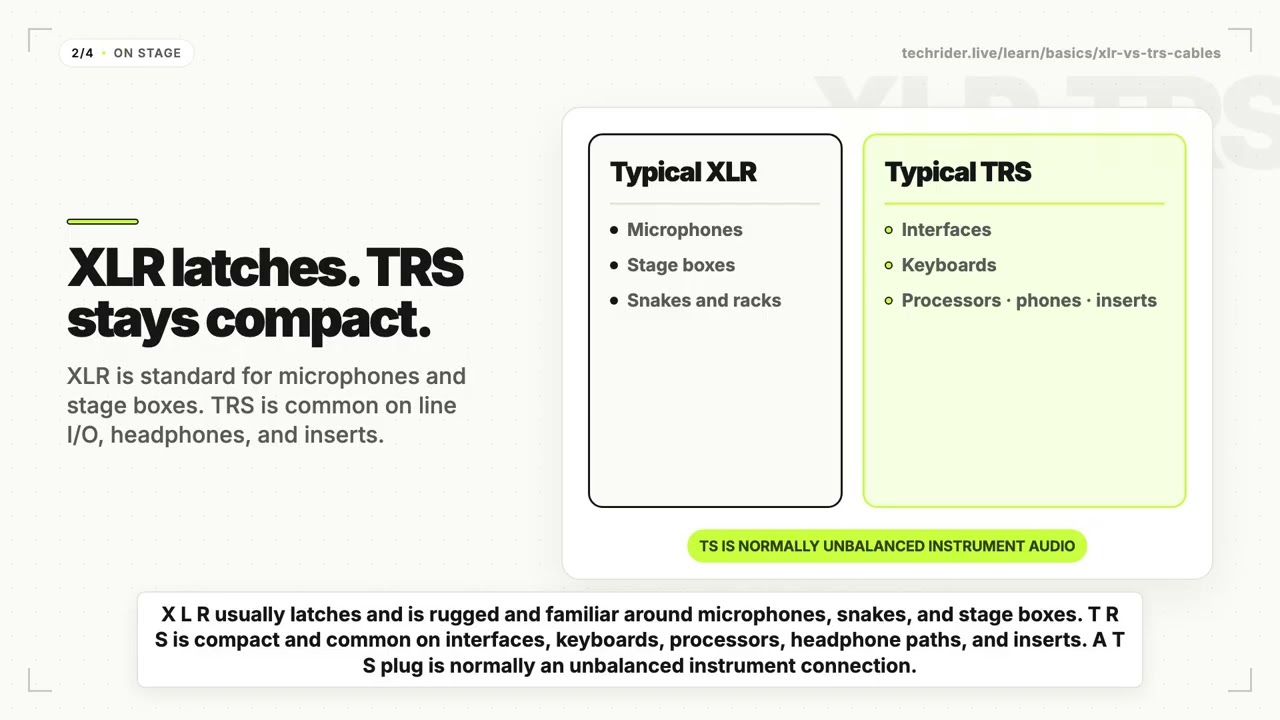 1:11Tutoriel vidéo
XLR vs TRS: Which Connection Should You Use?
XLR and TRS can both carry balanced audio, but the connector shape does not tell you the signal level or wiring by itself. Learn where each connector fits, what to verify before patching, and how t…
11 août 2026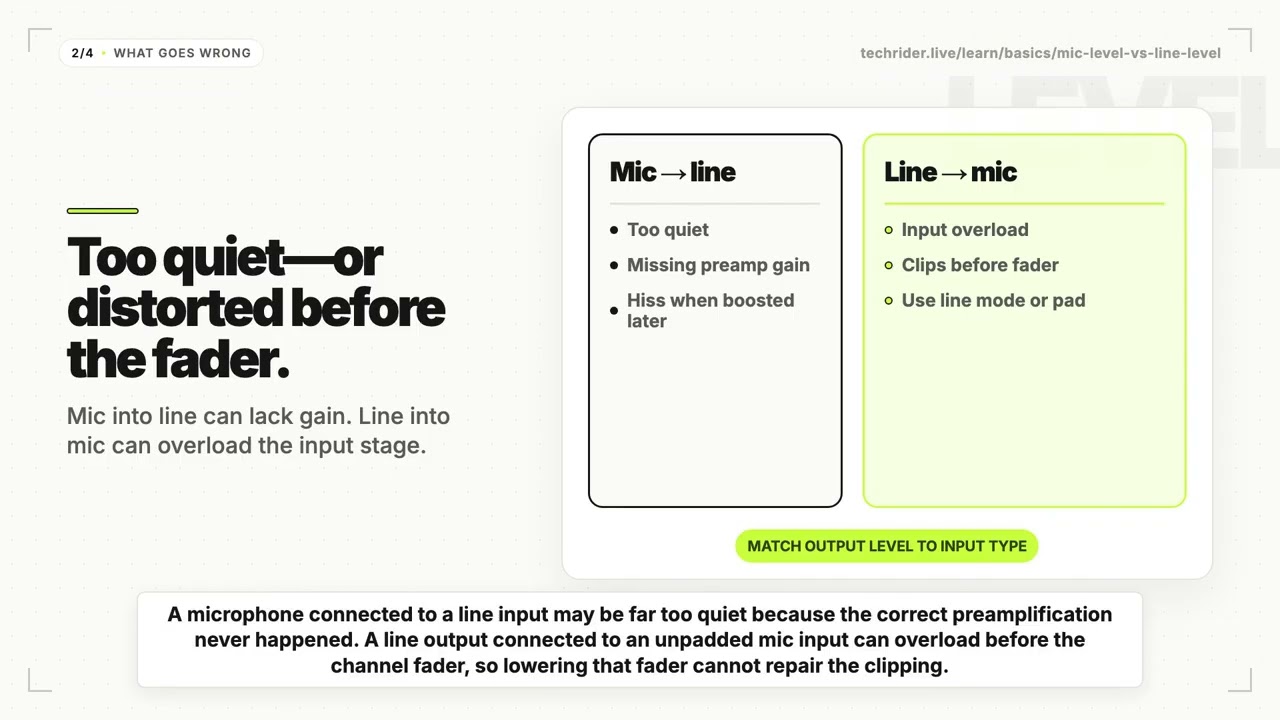 1:09Tutoriel vidéo
Mic Level vs Line Level: Live Sound Signals Explained
Mic level is the low output from a microphone; line level is the stronger operating level used between mixers, interfaces, and processors. Learn why mismatches cause noise or distortion—and how to …
11 août 2026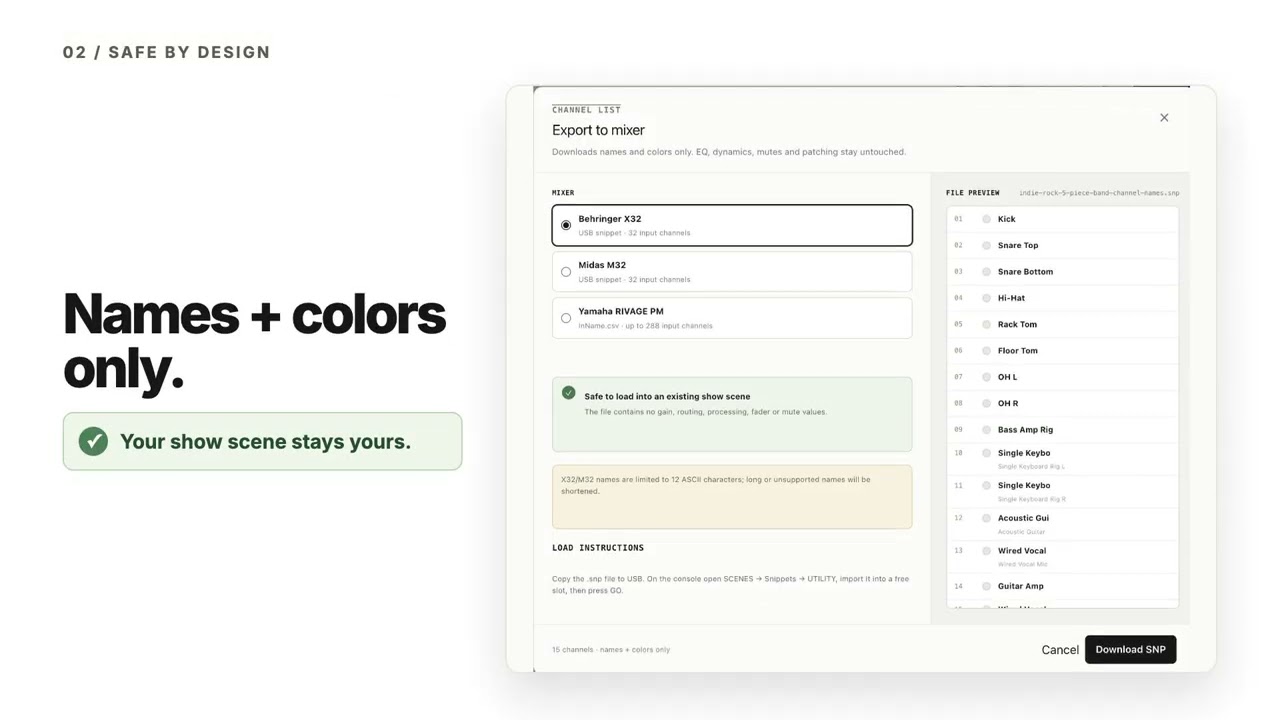 0:16Tutoriel vidéo
Stop Typing 30 Channel Names on Your X32 | Techrider.live
Export channel names and colors from one technical rider to Behringer X32, Midas M32, or Yamaha RIVAGE PM. The export contains no gain, routing, EQ, dynamics, fader, or mute values.
10 août 2026 1:05Tutoriel vidéo
What Is Phantom Power? 48V Explained + Safe Patch Order
How can 48-volt phantom power travel through the same XLR cable as audio?
9 août 2026 1:06Tutoriel vidéo
Balanced vs Unbalanced Audio: XLR, TRS and Noise Rejection Explained
A connector can physically fit and still carry the wrong signal.
9 août 2026 1:07Tutoriel vidéo
IEM vs Wedge Monitors: Which Is Better for Your Band?
In-ear monitors are not always better than wedges. Compare stage volume and feedback risk, isolation and mobility, RF planning, and how to document a hybrid monitor plan with stable mix IDs and fallbacks.
9 août 2026 1:02Tutoriel vidéo
What Is a DI Box? Active vs Passive DI Explained | Live Sound Basics
What does a DI box actually do—and why is it more than a simple 1/4-inch-to-XLR adapter?
9 août 2026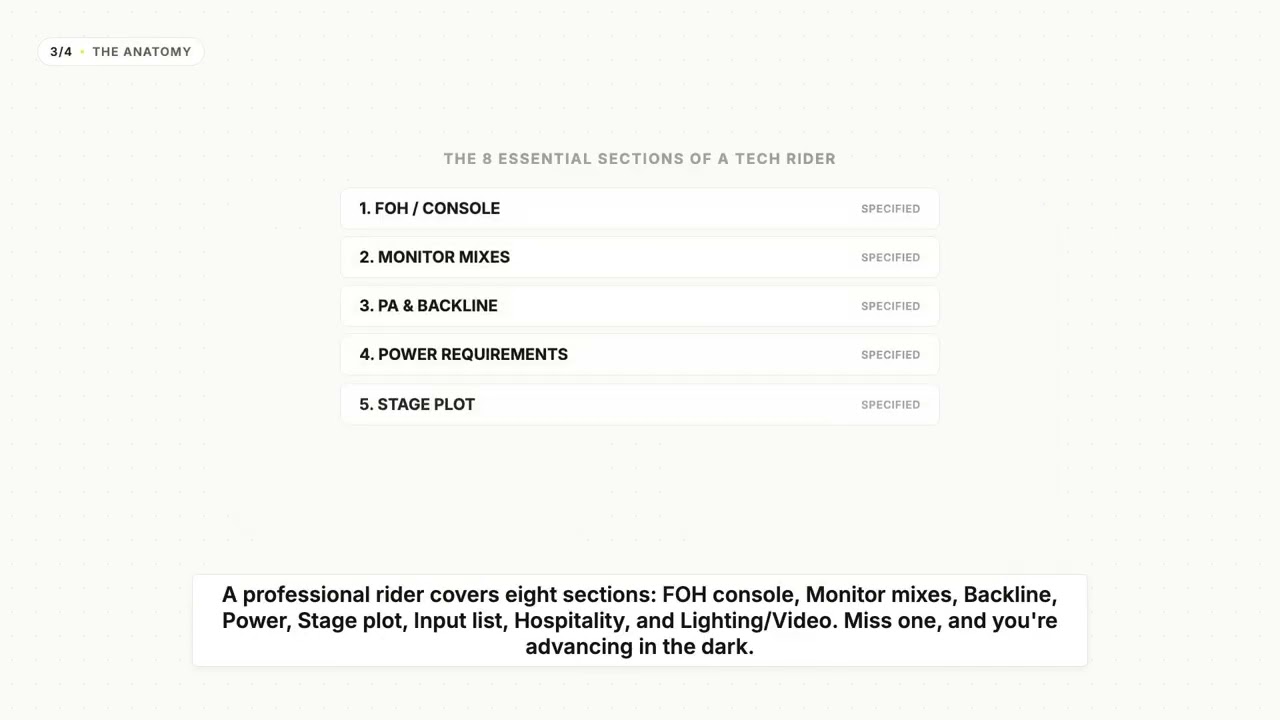 0:49Tutoriel vidéo
What Is a Tech Rider? Stage Plot vs. Full Technical Rider | Techrider.live
What a tech rider is, how a stage plot differs from a full technical rider, and why a live, always-current rider beats emailing static PDF attachments.
9 août 2026 1:22Tutoriel vidéo
Build a Solo Tech Rider in 10 Steps | Techrider.live
Build a complete solo tech rider — stage plot, input list, and monitor mix — from a blank stage, in about 80 seconds.
7 août 2026 0:26Tutoriel vidéo
Your Tech Rider, Finally Current — techrider.live
Your tech rider, finally current.
7 août 2026