Stage Left vs Stage Right (and Stage Directions Explained)
7 min read · Updated July 7, 2026 · new bands, stage managers, anyone new to stage terminology
Stage left and stage right are from the performer's perspective facing the audience — which is the mirror of what the audience sees. A clear, memorable explainer of stage directions, house left/right, and upstage/downstage.
TL;DR — Stage left and stage right are always from the performer's perspective, facing the audience. That means stage left is the performer's left — and the audience's right. Audience-side directions use a different word: house left and house right. Downstage is toward the audience, upstage is away from it. Remember the one rule and the rest falls into place.
Try it: Switch viewpoints and download a print card with the free Interactive Stage Directions Diagram. No login required.
The one rule that fixes everything
Almost every confusion about stage directions disappears once you lock in a single rule:
Stage directions are written from the perspective of the performer on stage, facing the audience.
Not the audience. Not the sound engineer at FOH. Not the camera. The performer, looking out at the crowd.
This convention exists for a reason that matters in production: it gives everyone a fixed reference point that doesn't change depending on where you happen to be sitting. A director in row 3, a stage manager in the wings, and a monitor engineer at side-stage can all say "stage left" and mean the same physical place — because all of them are describing it relative to the performer's orientation, not their own.
Once you internalize that, the terminology becomes a mirror you can hold up to any conversation.
Stage left vs stage right
With the rule in hand, the definitions are simple:
- Stage Left (SL) — the performer's left-hand side when standing on stage and facing the audience.
- Stage Right (SR) — the performer's right-hand side when standing on stage and facing the audience.
That's it. "Exit stage left" means the performer walks to their own left.
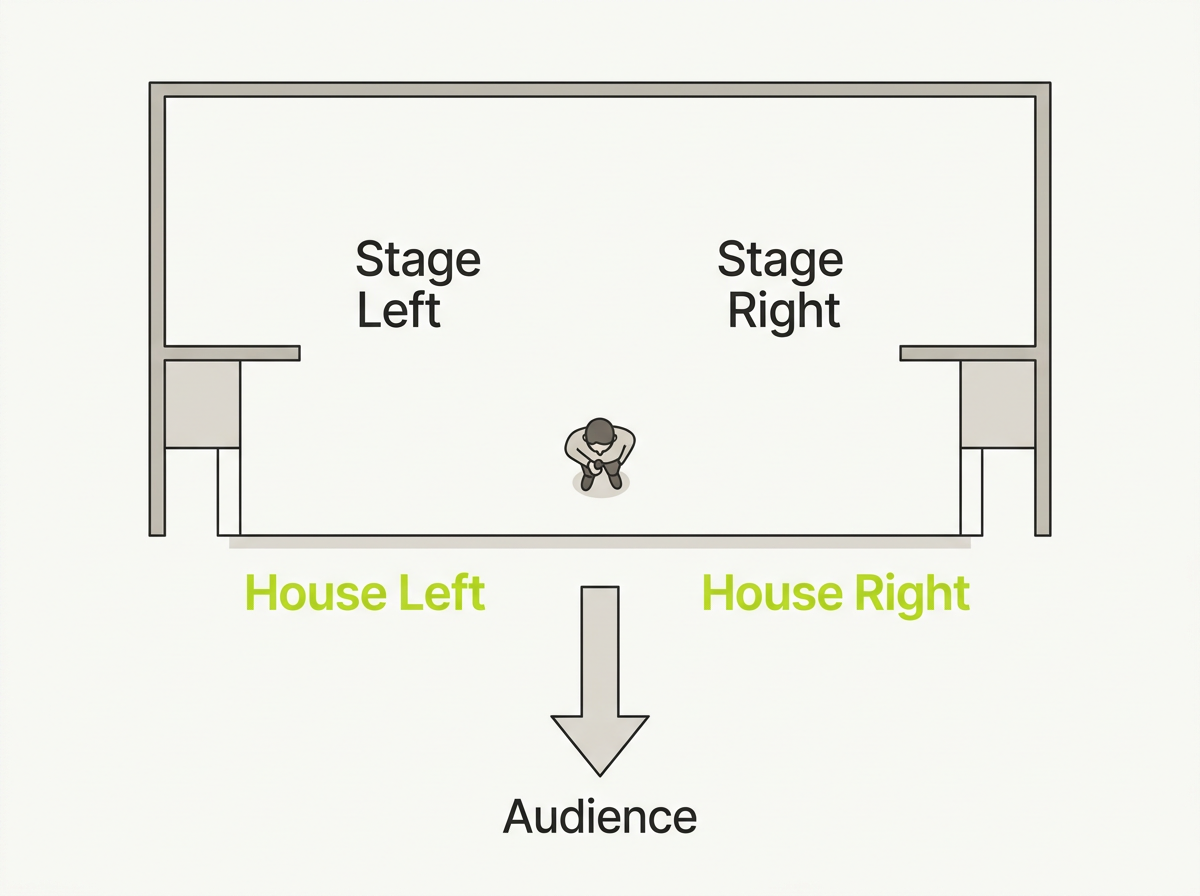 Fig. 1 — The mirror: stage left/right are from the performer's perspective facing the audience; house left/right are from the audience's perspective facing the stage. SL and HR share a side; SR and HL share a side.
House / audience left vs right
When you need to describe a side from the audience's point of view, you switch vocabulary. The audience doesn't use "stage left" — they use house directions:
- House Left (HL) — the audience's left-hand side when sitting and facing the stage. Physically the same side as Stage Right.
- House Right (HR) — the audience's right-hand side when facing the stage. Physically the same side as Stage Left.
Because the performer and the audience face each other, their lefts and rights are reversed. So the single sentence people get tripped up on — "is stage left the audience's right?" — has a clean answer:
Yes. Stage left is the audience's right (House Right). Stage right is the audience's left (House Left).
This is the entire reason two vocabularies exist. "Stage" directions belong to the performer; "house" directions belong to the audience. Say what you mean and there's no ambiguity.
In practice, on a live-sound crew you'll hear both — often from different people in the same minute. The FOH engineer might say "the wedge on house left" while the stage tech says "move that wedge upstage right." They can be describing gear on the same side of the building, framed from two different standpoints. Knowing both vocabularies is what keeps a load-in from turning into a compass argument.
Upstage, downstage, center
Left and right aren't the whole map. A stage also has depth, described with a vocabulary that comes straight from theatre history.
- Downstage (DS) — the part of the stage closest to the audience.
- Upstage (US) — the part of the stage farthest from the audience, toward the back wall.
- Center Stage (C) — the middle of the stage, often written as just "center."
Combine depth with left/right and you get the nine standard positions — downstage left, center stage, upstage right, and so on. A stage plot labeled "drums downstage center" puts the kit mid-stage, nearest the crowd.
Why is it called "upstage"?
Modern stages are flat. But for centuries, stages were raked — built on a slope that rose toward the back, so an audience sitting on flat ground could still see actors at the rear. The back of the stage was literally higher than the front.
- Walking toward the audience meant walking down the slope → downstage.
- Walking away from the audience meant walking up the slope → upstage.
The slopes are gone, but the words stuck. (The verb "to upstage someone" — stealing focus from another performer — comes from the same place: an actor who moved upstage forced the others to turn partly away from the audience to face them.)
Why stage plots use the performer's perspective
If you've read What Is a Stage Plot?, you know a stage plot is a top-down map of your setup. Here's the part that matters for this article: a stage plot should always be labeled from the performer's perspective.
Three reasons:
- It's the industry default. Sound engineers, stage managers, backline techs, and tour managers all read directions the performer-centered way. Labeling differently forces every reader to translate — and translations breed errors on a tight load-in.
- It travels. A plot sent to ten different venues needs one consistent frame of reference. Performer-centered labels mean a stranger reading it cold interprets it the same way your own crew does.
- It pairs cleanly with an input list. When channels and stands are placed "stage left" on the plot and patched "stage left" on the channel sheet, the two documents agree. (See Stage Plot Symbols & Legend Explained for keeping that vocabulary consistent.)
A common beginner mistake is drawing the plot as if you were sitting in the audience — easy to do, since that's how most of us see a show. The fix is to always orient the plot so the audience is at the bottom (or clearly marked with an audience-direction arrow) and the labels read from the performer facing out. That single orientation choice eliminates almost every "wait, which side?" question.
A quick way to remember it
If you forget everything else, keep two mnemonics:
- "Stage belongs to the performer; house belongs to the audience." They face each other, so they're mirrors: SL = HR, SR = HL.
- "Downstage is down toward the crowd; upstage is up the (old) hill." Down = audience; up = back wall.
And when in doubt on a gig: state your frame. "Stage left — the performer's left" costs two extra words and removes all doubt.
FAQ
Is stage left from the audience or performer perspective? From the performer's perspective, facing the audience. Stage left is the performer's left hand. The audience's equivalent term is house left/right, and from the audience's seat, stage left appears on their right.
Which side is stage left? Stage left is the left side of the stage as seen by a performer standing on it and looking out at the audience. To someone sitting in the audience, that same side is on their right.
What is downstage and upstage? Downstage is the area of the stage closest to the audience; upstage is the area farthest from the audience, toward the back. Center stage is the middle. Combined with left/right you get positions like "downstage left."
Why is it called upstage? Because early theatre stages were raked — sloped upward toward the back so the audience could see rear actors. Walking to the back meant going physically up the slope (upstage); walking toward the audience meant going down (downstage). The slope is gone; the vocabulary stayed.
Is stage left the audience's right? Yes. Because stage directions use the performer's perspective and the performer faces the audience, the two are reversed: stage left = house right, and stage right = house left.
What's next
- 🗺️ What Is a Stage Plot? (And How to Read One) — where these directions actually get used.
- 🔣 Stage Plot Symbols & Legend Explained — keep your labels consistent.
- ✏️ Ready to label your own? Open the stage plot editor and orient it from the performer's perspective.
Further reading
- Stage areas, directions and positions in theatre — Captitles
- The Nine Stage Positions — BBC Bitesize GCSE Drama
- Upstage / Downstage: Why Is It Called That? — Experiments in Theater
Last updated: 2026-07-07 · Reviewed by the Techrider.live team · Cross-checked against standard theatre and live-sound stage-direction conventions.
Related guides
What Is a Stage Plot? (And How to Read One)
A stage plot is a top-down map of your band's stage setup. Learn what goes on it, how it differs from an input list and tech rider, and what makes one engineer-readable.
6 min readBasicsWhat Is a Tech Rider? (Sections Explained)
A tech rider is the full technical package a band sends a venue — console, monitors, PA, backline, power, stage plot, input list, hospitality. Learn every section.
7 min readBasicsStage Plot Symbols & Legend Explained
A visual glossary of stage plot symbols — mics, DI boxes, wedges, IEM packs, drums, amps, keys, power drops. Learn what each icon means and how to read any stage plot.
7 min read