What Is a Tech Rider? (Sections Explained)
7 min read · Updated July 7, 2026 · new bands, production managers
A tech rider is the full technical package a band sends a venue — console, monitors, PA, backline, power, stage plot, input list, hospitality. Learn every section.
TL;DR — A tech rider (short for technical rider) is the complete technical package a band sends to a venue, promoter, or festival so they can prepare the show. It usually covers FOH/console, monitors, PA and backline, power, the stage plot, the input list, and often hospitality and lighting/video. It's the full spec sheet — not just the picture of the stage.
What is a tech rider?
The technical rider meaning is straightforward: it's the bundle that tells a venue what you need to perform. Console and channel count, monitor mixes, PA and backline, power, stage layout, the input list, and frequently hospitality. Anything the venue has to provide, rent, patch, or prep goes in here.
The easy mistake is to confuse the rider with one of its parts. The stage plot is the map — where things go. The input list is the table — what each channel is. The tech rider is the whole package: plot + list + everything else wrapped around them. (What is a stage plot? →)
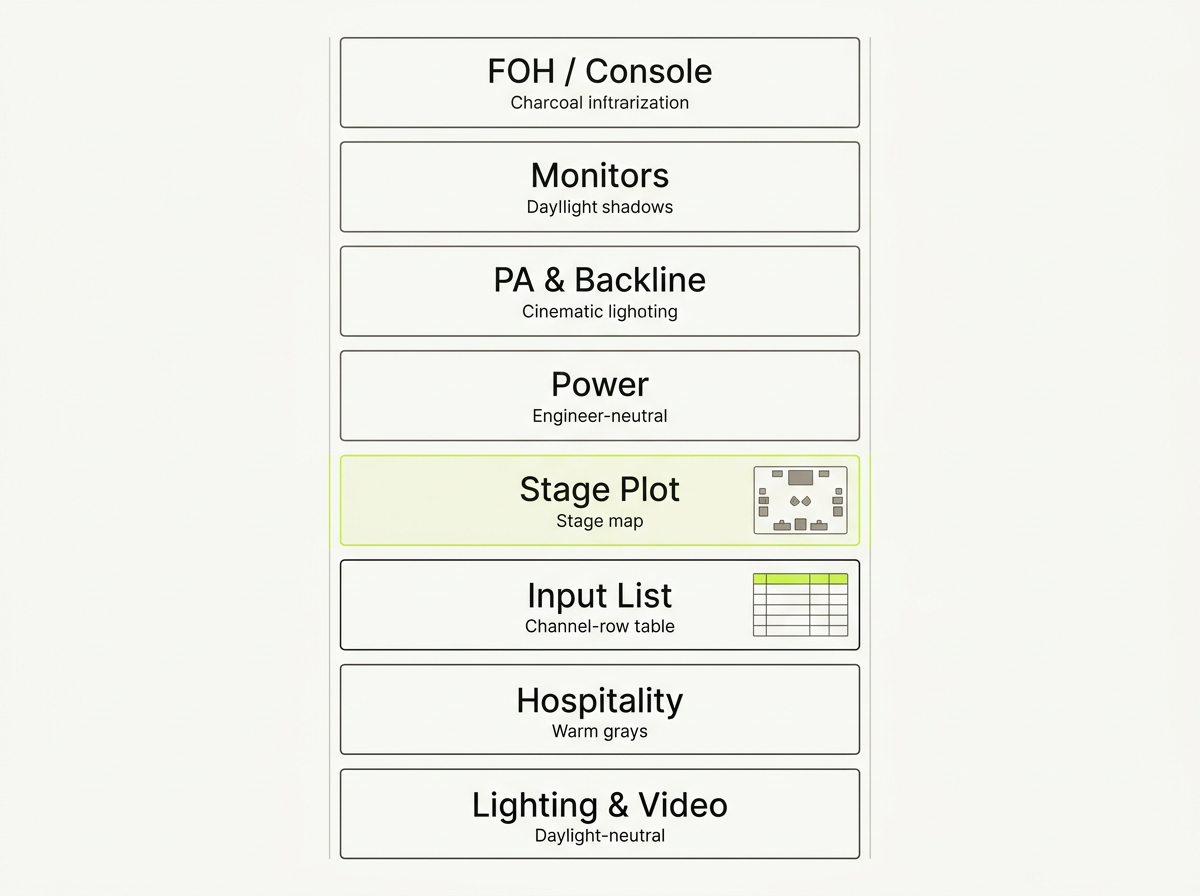 Fig. 1 — A tech rider is a stack of sections; the stage plot and input list are two of them.
What should a tech rider include? (The sections)
There's no single mandatory template, but most working band tech riders cover the same ground, roughly in the order engineers expect them.
1. FOH / console
What front-of-house console you prefer or require, your channel count, and any outboard needs. For festivals this is critical — and "preferred" vs. "required" is the difference between a smooth advance and a refused contract.
2. Monitors
How many mixes, wedges vs. in-ear monitors (IEMs), and who's on what mix. State the mix count, destinations, and whether you bring your own IEM system.
3. PA & backline
PA is the house sound system; backline is the venue-supplied instrument gear — amps, drum kit, keyboards, sometimes a bass rig. List what you carry and what you need the venue to provide.
4. Power
Where you need AC on stage and roughly how much. Multiple high-draw rigs on one circuit is how shows go dark mid-set — mark drops on the plot and total them here.
5. Stage plot
The top-down map: every performer, instrument, mic, DI, monitor, and power drop in place. The section everyone recognizes — but only one section. (What is a stage plot? →)
6. Input list
The channel-by-channel table: number, name, mic/DI, stand, phantom power, patch notes — the document the patch tech works from. The most damaging error is channel numbers that don't match the plot. (Input list vs patch sheet →)
7. Hospitality (and schedule)
Often a separate hospitality rider, folded in at smaller venues: catering, water, parking, load-in/soundcheck/doors times. Non-technical in name, but it rides along.
8. Lighting & video
Lighting cues, video, projection, screens. Small-club bands often skip it — fine. It's essential for theatre, corporate, and larger tours.
Not every show needs all eight. A duo in a 100-cap room may skip lighting; a theatre tour may add video. The list is a map of the territory, not a mandatory form.
Stage plot vs tech rider
These get conflated constantly:
- The tech rider is the whole package.
- The stage plot is the map — one piece of that package.
Send only a stage plot and you've answered where but left what console, how many mixes, who's providing the bass amp unanswered. The plot is necessary; it's not sufficient. (Read the deep dive →)
Who needs a tech rider?
Short answer: anyone playing a show that someone else has to prepare.
- Bands and artists — you produce it; it travels ahead to every venue, promoter, and festival booker.
- Production managers (PMs) — they own and update the rider across a tour, version it per show, and route it.
- Venues and festivals — they consume it. A good rider lets them patch, place gear, and staff the show before you arrive.
- Sound and monitor engineers — they read the input list and monitor section like a brief.
Many bands assume riders are only for big tours. In practice, the smaller the room and the tighter the changeover, the more a clear rider saves everyone's night.
What makes a good tech rider
A weak rider and a strong rider can describe the same band. The difference is three qualities:
- Complete — every section a venue might need is there, even if some say "not required." Absence reads as "we forgot."
- Consistent — channel numbers on the plot match the input list, monitor mixes match their destinations, the backline list matches what's drawn on stage. Cross-document drift is the #1 source of day-of errors.
- Current — it reflects the show you're about to play, not last year's lineup.
That third quality is where most riders quietly fail. Bands email a PDF; the lineup changes a week before the gig; nobody updates it; the venue patches against a ghost.
Living document vs static PDF
This is the argument for treating a tech rider as a living document:
- A static PDF gets emailed, printed, archived — and frozen the moment you export it.
- A live link is always the latest version, so the venue is never looking at stale gear.
- Multi-editor collaboration — the owner invites collaborators (your engineer, TM) to open, edit, save, export, and inspect history on the same rider — keeps it current without emailing revised PDFs back and forth.
The healthiest workflow uses both: one source of truth that emits a fresh PDF and a live link from the same data. (Real-time co-editing and team workspaces are on the roadmap; today the model is asynchronous multi-editor collaboration.)
→ See the full case for this approach: Why Your Tech Rider Should Be a Living Document
FAQ
What is a tech rider? A tech rider (technical rider) is the full package of technical requirements a band or artist sends to a venue — console, monitors, PA, backline, power, stage plot, input list, and often hospitality and lighting. The stage plot is one section inside it.
What should a tech rider include? The standard sections are FOH/console, monitors, PA and backline, power, stage plot, input list, hospitality, and (where relevant) lighting and video. Not every show needs all eight, but completeness matters.
Is a tech rider the same as a stage plot? No. The stage plot is the top-down map of where things go on stage. The tech rider is the whole package, of which the plot is one part — alongside the input list, console and monitor specs, power, backline, and more.
Who needs a tech rider? Any act playing a show that someone else has to prepare — and the venues, festivals, PMs, and engineers on the receiving end. Smaller rooms benefit most, because tighter changeovers leave less room for day-of surprises.
What is backline? Backline is the instrument gear a venue supplies or shares — typically amps, a drum kit, keyboards, and sometimes a bass rig. Your rider states what you carry and what you need the venue to provide.
What's next
- 📄 What is a stage plot? (and how to read one)
- 📋 Input list vs patch sheet: what's the difference?
- 🔄 Why your tech rider should be a living document
- 🛠️ How to write your first tech rider
Further reading
- What is a Technical Rider and why do I need one? — Improvised Music Company
- What is a Technical Rider? (Plus Real Examples & Stage Plots) — The Rock Factory
- Understanding the Technical Rider — Silver Creek Audio
- Rider (theater) — Wikipedia
Last updated: 2026-07-07 · Reviewed by the Techrider.live team · Tested against real festival and club tech riders.
Related guides
What Is a Stage Plot? (And How to Read One)
A stage plot is a top-down map of your band's stage setup. Learn what goes on it, how it differs from an input list and tech rider, and what makes one engineer-readable.
6 min readBasicsStage Plot Symbols & Legend Explained
A visual glossary of stage plot symbols — mics, DI boxes, wedges, IEM packs, drums, amps, keys, power drops. Learn what each icon means and how to read any stage plot.
7 min readBasicsStage Left vs Stage Right (and Stage Directions Explained)
Stage left and stage right are from the performer's perspective facing the audience — which is the mirror of what the audience sees. A clear, memorable explainer of stage directions, house left/right, and upstage/downstage.
7 min read