Backline Rider Requirements: What to Include
7 min read · Updated July 16, 2026 · tour managers, production managers, bands, backline vendors
Write a backline rider that tells venues what to supply, what you carry, acceptable substitutions, setup ownership, and approval rules.
TL;DR — A backline rider is the section of a technical rider that defines the instruments and stage equipment required for a performance. For every item, state who supplies it, the exact quantity and specification, acceptable alternatives, included accessories, setup location, and who approves substitutions. Separate “artist carries” from “venue or promoter provides,” and never rely on a model name alone when the operational requirement can be described.
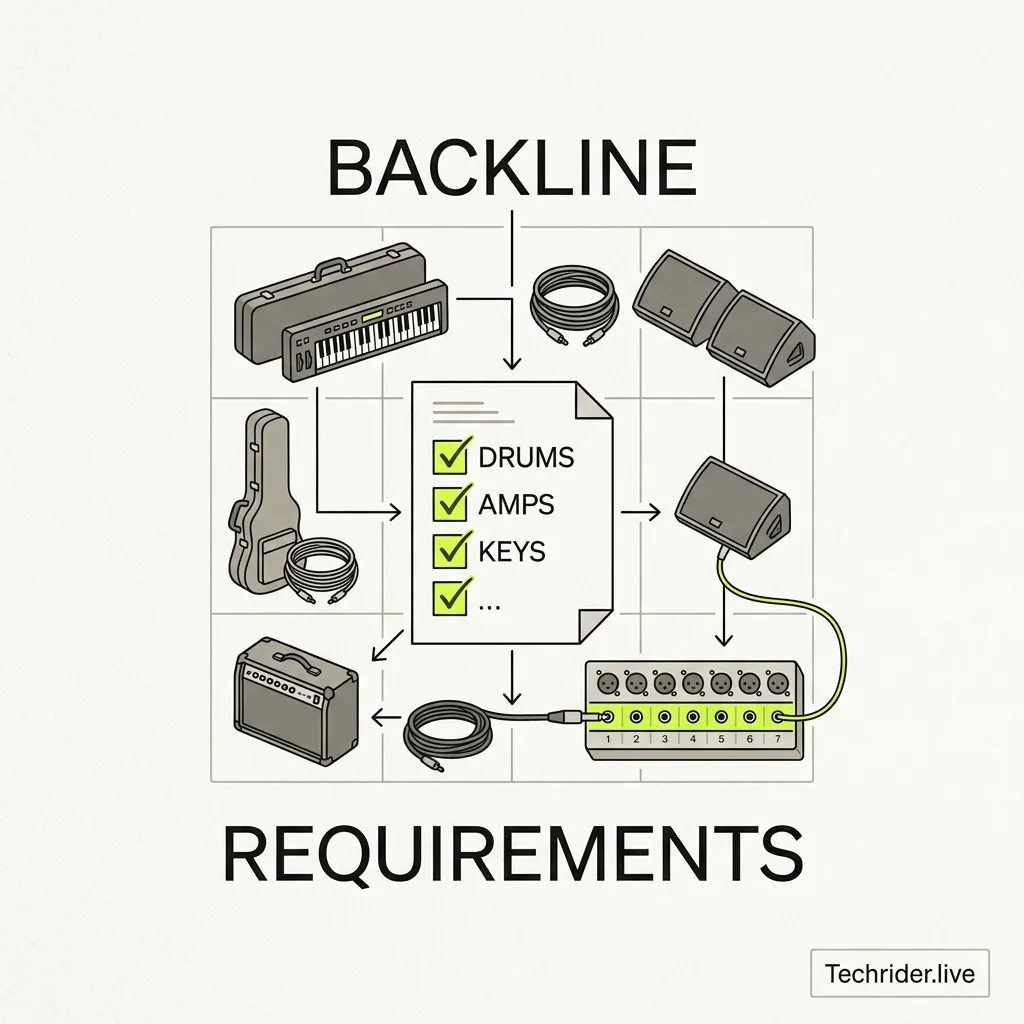
Table of contents
- What is a backline rider?
- What counts as backline?
- The backline requirements template
- How specific should each request be?
- Shared backline and festival changeovers
- How to approve substitutions
- Pre-send checklist
- FAQ
What is a backline rider?
A backline rider is the equipment-supply plan for the instruments and supporting stage gear used by an artist. It may be a dedicated document for a fly date or a clearly labeled section inside the full tech rider.
Its job is to remove five ambiguities before load-in:
- what the artist brings;
- what the venue, promoter, or rental vendor supplies;
- what “equivalent” actually means;
- which accessories are included;
- who can approve a change.
A useful backline list is not a shopping wish list. It is a handoff between performers, production, purchasing, vendors, and stage crew. Every line should be specific enough to quote, source, prepare, and verify.
What counts as backline?
In live music, backline commonly includes instruments and amplification placed on or near the stage: drum kits, guitar and bass amplifiers, keyboard rigs, pianos, DJ equipment, percussion, and associated stands or hardware. Usage varies between productions, so define the boundary in your rider instead of assuming everyone uses the word identically.
| Usually treated as backline | Usually documented elsewhere |
|---|---|
| Drum shells, hardware, cymbals when supplied | PA loudspeakers and system processing |
| Guitar and bass amplifiers or cabinets | FOH and monitor consoles |
| Keyboards, piano, stands, pedals, benches | Microphones, DIs, stands, cabling |
| DJ players, mixer, performance table | Stage boxes, split, and house patch |
| Percussion, stools, instrument stands | Lighting, video, rigging, and power distribution |
The right-hand items can still be supplier-provided requirements; they simply belong in the audio, stage, lighting, or electrical sections. Keep each item in one authoritative place and link the sections rather than duplicating conflicting lists.
The backline requirements template
Use one row per independently supplied item or matched set.
| Field | What to write | Example |
|---|---|---|
| Item ID | Stable short reference | BL-03 |
| Quantity | Required count | 1 |
| Item | Plain-language equipment type | Bass amplifier head |
| Preferred specification | Model or operational characteristics | 500 W minimum at supplied cabinet load |
| Acceptable alternatives | Named models or performance envelope | Professional touring head, approved in advance |
| Accessories | Everything needed to use it | Power cable, speaker cable, footswitch if required |
| Supplier | Artist / promoter / venue / vendor | Promoter-provided |
| Placement | Stage position or riser | Upstage stage left |
| Setup owner | Who assembles and tests it | Backline vendor |
| Approval | Person who accepts substitutions | Tour production manager |
Then add document-level information:
- artist and production contact;
- show or tour scope;
- currency and tax basis if prices are included;
- delivery, setup, tuning, collection, and labor expectations;
- approval deadline;
- version date and revision identifier.
Copyable backline row
BL-___ | Qty ___ | Item: ____________________
Preferred: __________________________________
Acceptable alternative / required capability: __________________________
Accessories included: _______________________
Supplied by: __________ | Positioned: ________
Setup/testing owner: ___ | Approval contact: ______________
How specific should each request be?
Be exact where a detail affects performance, compatibility, safety, or setup time. Be flexible where several professional products produce the same operational result.
Drums
State shell sizes, number of toms, finish only if contractually important, hardware, throne, rug, pedal arrangement, and whether cymbals, snare, and kick pedal are artist-carried. “Five-piece drum kit” is incomplete because different people count pieces differently and it says nothing about stands or hardware.
Guitar and bass rigs
Separate head and cabinet requirements. Include impedance or matching requirements where relevant, speaker configuration, channels, switching, effects-loop needs, and whether the artist carries a load box or modeler. If the musician only needs a clean platform with enough headroom, say that instead of insisting on one scarce model.
Keyboards and piano
Specify exact instrument or key count, weighted action, stand type, sustain and expression pedals, bench, stereo or mono output, and local voltage. For acoustic piano, include tuning timing, pitch reference if nonstandard, bench, lid orientation, and environmental constraints.
DJ equipment
List player and mixer model/firmware requirements, quantity, linked networking needs, media format, table dimensions and load, booth-monitor control, and artist output connector. The DJ Tech Rider guide provides a complete handoff pattern.
Shared backline and festival changeovers
Shared backline saves space and changeover time only when ownership is explicit. Create a matrix that distinguishes the common base from each artist's personal items.
| Item | Festival supplies | Artist carries | Changeover action |
|---|---|---|---|
| Drum shells | Kick and toms | Snare, cymbals, pedal | Swap personal package; reset heights |
| Bass cabinet | Shared cabinet | Head and cables | Connect, verify load, line check |
| Keyboard stand | Two-tier stand | Keyboards and pedals | Place loom and artist rig |
Never promise one artist's equipment to another without the owner's permission. Record who may adjust drum hardware or amplifier settings, where cases wait during the set, and whether shared equipment remains patched. For the wider process, use the Festival Stage Plot and Changeover Guide.
How to approve substitutions
A substitution request should preserve the original requirement and explain the effect of the offered alternative.
Requested: [item and specification]
Offered: [exact item, condition, included accessories]
Difference: [control, size, output, compatibility, feel, or workflow]
Operational effect: [none / show-file change / extra setup / artist review]
Decision needed by: [date and time]
Approved by: [name and role]
Do not silently edit the original request after approval. Keep the rider as the touring baseline and record the accepted local substitution in the show advance. That preserves a reusable source while giving the day-of crew the actual plan.
Pre-send checklist
- Every item has a quantity and supplier
- Models include an operational reason or acceptable alternative
- Small but essential accessories are listed
- Voltage and connector compatibility are confirmed
- Drum and keyboard hardware is unambiguous
- Setup, tuning, testing, and collection labor is assigned
- Shared items and artist-carried personal items are separated
- Substitutions require named approval
- Backline positions match the current stage plot
- Audio outputs match the current input list
- The document has a version date and production contact
FAQ
What is a backline rider?
A backline rider is the equipment section of a technical rider that specifies the instruments, amplifiers, hardware, and supporting stage gear an artist needs, including who supplies each item and which alternatives are acceptable.
What equipment is considered backline?
Backline commonly includes drum kits, guitar and bass rigs, keyboards, pianos, DJ equipment, percussion, and related hardware. PA, consoles, microphones, lighting, and power distribution are normally documented in their own production sections.
Who provides backline for a concert?
The artist may tour with it, or the venue, promoter, festival, or specialist rental vendor may supply it. The rider must assign every item rather than relying on a general statement such as “full backline provided.”
Is a PA system part of the backline?
Usually no. A PA system is sound-reinforcement equipment and belongs in the audio-system requirements. Because terminology varies, define your rider's categories explicitly.
Should a backline rider list exact brands and models?
List exact models when compatibility or performance depends on them. Otherwise describe the required capability and give acceptable alternatives. This makes sourcing easier without weakening an essential requirement.
Keep backline connected to the whole Rider
Create a reusable Rider with Techrider.live, place backline on the stage plot, match its outputs to the input list, and send the venue one current live link plus a dated PDF.
Last updated: 2026-07-16 · Reviewed by the Techrider.live team for touring, fly-date, and festival production handoffs.
Related guides
How to Make a Stage Plot for Your Band (5-Minute Guide)
A 5-step walkthrough to make a clean, engineer-readable stage plot for your band — set the stage, place performers, add gear and mics, then export a PDF and share link.
9 min readTutorialsFree Stage Plot Template (Download + How to Use)
A stage plot template is a pre-laid-out starting point for your band's stage map. Pick one of four shapes, customize performers and gear, and export a PDF.
9 min readTutorialsHow to Build an Input List / Patch Sheet (with Template)
A channel-by-channel table of every source on stage. Learn the input list columns, the drums-to-vocals ordering, 48V and DI rules, and how a patch sheet differs.
7 min read